I never liked biopics movies, and for a while I couldn't quite put my finger on why.
Sure, I've nitpicked about inacuracies in the few I saw that were about a topic I thought I knew something about, and I've complained about how they always focus way too much on the glamour and the drama. But I could feel there was something deeper that bothered me about them.
Part of it is simply that a movie is not the same thing as a documentary. The latter is mostly concerned with facts, while the later is all about telling a story.
Stories need themes, characters, plot, rhythm and all that jazz that real life doesn't care about. No matter how accurate the script might strive to be, the very act of telling the story is bound to color the reality, which is why complaining about whether or not a scene accurately portrays whatever happened is missing the point.
And that's fine. If the author has something interesting to say, I don't see why you couldn't end up with something great.1 But the whole idea of waving a story around the life of a real person feels weird to me, and even though I would consider myself a story nerd, I tend to enjoy a good documentary a lot more than the embelished biography of an already established celebrity.2
Which gets to my main point:
I've touched on the worship of individuals on here before, and I learned to be very wary of it as a young adult. And biopics, being forced to conform to a narrative structure, can't avoid focusing on their protagonist.3 Again, this would be fine in a complete fiction, but once we're dealing with real events that happened in the real world, I can't help but see them as a symptom of the cult of personalities that's so ingrained in our current culture.
People should be celebrated for what they've done, not for who they are / were. I get that the life of someone can give valuable insight for understanding whatever she accomplished, but where a regular documentary can take a step back and present multiple viewpoints when it's time to give some context, it's much harder to put things into perspective once the goal switched from relating facts to telling a tale.4
I've been told some were pretty critical of the personality they were portraying, and I'm sure they can be. But while I sure don't mind dumping on Zuckerberg, turning him into a villain instead of a hero still contributes to turn him into some bigger-than-life figure and distracts from a more structured critique of the dystopian world the man helped to build.5
Changing my mind over a Pinball game.
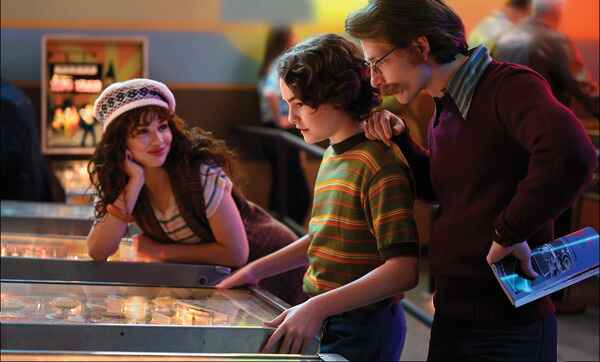
Two years or so ago, a friend of mine6 suddenly got into pinball. He'd chat about it now and then, and around last December he recommended me a movie which tells a rather peculiar story:
Back in the 70's, several US cities had banned pinball machines because they were associated with the illegal casinos operated by the mafia, and the ban got lifted after a man called Roger C. Sharpe demonstrated before the New York city council that the game depended on skill rather than chance, and therefore didn't fit the definition of gambling.
And that's pretty much it. It's a neat little anecdote, but how in hell could you possibly stretch it to fit a feature-length film ?
The production's answer to this question is to embrace the whole biopic approach, and to basically tell us the life of Sharpe, from his arrival in New York after a divorce, looking for a job, and, of course, meeting and falling in love with a young single mother.
The end result is a pretty feel-good love story, which happen to mention but doens't revolve around an interesting, if rather trivial historical event. The writing is great and keeps things from getting sappy, and the movie is just quirky enough to stay interesting and very lightly touches on a few social issues, without ever taking itself too seriously.7
Honestly, this may be the best film I've watched over the last ten years. And it's a biopic. Didn't I just rant about how I hated that genre ?
Well, yes, but that one's different, because this time it's not about a celebrity. The real Roger Sharpe got his fifteen minutes of fame and went on with his life, remaining unknown to the general public. I don't think anyone outside of Pinball afficionados ever heard of him before this film was made.
And this changes everything.
There's no need to make the characters bigger than life, and I don't give a damn if the story's embelished, because for once we're not talking about someone that's already famous. Sharpe is portrayed like a nice, regular guy, not like some genius that we should worhip.
I guess it's just nice to pay tribute to one of the little people instead of gushing once again about someone society already decided to call great. We should do a lot more of that.
Celebrities, by definition, already got their recognition. So let's focus on the smaller stories, the ones with a human scale. Those might not seem like they matter much in the grand scheme of things, but they do, and they'll always be much more compelling to me than collectively praising yet another god-like figure.
Also, just look at this magnificent 'stache:
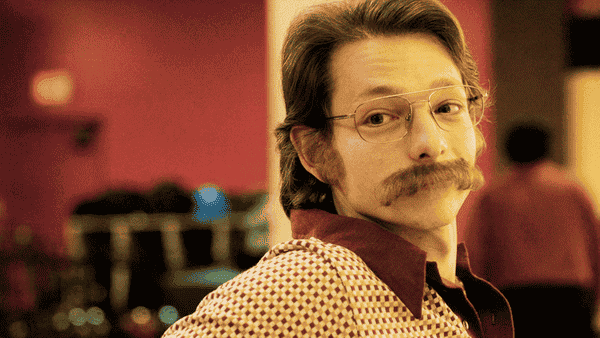
If that doesn't convince you, I don't know what will.
Credits:
Featured image is from https://www.thoughtco.com/history-of-pinball-1992320
The other photos are stock screenshots from the movie.
-
I have actually seen very few biopics to begin with, so I can't claim they're all bad. The general discussions I hear about them usually fails to tempt me, though. ↩
-
In fact, while I haven't seen it, I always thought the premise of Gus Van Sant's "Last Days" sounded a lot more interesting:
The movie is technically a fiction and while its depressed rock star protagonist is obviously based on Kurt Cobain, it's still a made up character, which leaves the director free to say what he wants without the pretense of telling us a true story.
I don't know how it turned out, but at least I can see how that approach could be interesting. ↩
-
Maybe some manage to avoid this. I'm sure those are among the ones that could potentially interest me. But they sure don't seem tp be the norm. ↩
-
I'm not pretending documentaries are neutral and objective. Of course they can be heavily biased, too. But their very structure at least allows them to bring some nuance if they chose to do so. ↩
-
To be fair, I haven't see that movie either, so that's not a criticism on its subtext. Maybe the film does manage to make a great point and to get it across. I'm just wary of the general premise. ↩
-
Hi, Nico! ↩
-
The movie constantly makes fun of its own premise, and never pretends to be any deeper than it really is. ↩